Congratulations- you survived and made it to Spring! I cannot tell you the relief I am feeling with the sunshine on my face. Suddenly, everything feels a lot more positive. Painting feels easier, Leela is happier not being covered in mud after her walks, and I don’t have to put a fire on first thing in the morning.
Finally, it feels like I can enjoy boat life again.

And with that comes the ability to create real content. I have been busy filming and editing videos, the first to be released this Friday and I have been incredibly excited about its subject matter- World War Two on the canals.
With Maggie being built in 1928 and worked on by the people that would have been alive during the First World War, delving into the WW2 felt natural. Maggie was based in Birmingham during the bombings, where she suffered a wall collapse at Gas Street Basin. All of that, she survived.
As you may well know, I have been writing a book about the lost history of women of the waterways- one of my favourite segments is about the Idle Women of the canals. It felt quite poignant to me that my boat would also be “doing her bit”, still working as a haulage boat, (for Samual Barlow at that point) and it occurred to me, what would it be like to live and work on these canal boats during the war? And not just that- what would it be like for the people on land as they coped through rations and growing their own food?
Which led me to my next experiment.
Dig For Victory.

Initiated in 1939, the UK Government called the public to join “The Garden Front”, encouraging all to start growing their own food. It was a concern that with our ships being targeted by the enemy, that Hitler would attempt to starve us into surrender. Our ships were also needed to move our armed forces, weapons and supplies to fight in the war. With our pre-war stats of having 75% of our food imported, the Government knew that something would have to be done. We needed to be as self sufficient as possible.

Flowers were pulled up in every garden and replaced with potatoes, carrots, onions and anything else you could stick in the soil. Nothing was wasted or thrown away. Full dedication was required. Verges, public parks, and even Buckingham Palace’s gardens were revolutionised.
This was one of the reasons I decided to make the leap and get myself an allotment.
I have been boating for about eight years now. I have never had my own bricks or mortar- or my own garden, and I have no idea when I will get to that point in my life. The one thing I do yearn for is my own space where I can grow fruit and veg.
But surely you can plant some flower boxes on your roof, Elizabeth?
I don’t want a boat roof garden of a couple of boxes.
I want a proper garden where Leela can play whilst I rake and dig beneath the sun and eventually collapse into a chair where I can have a glass of cider with my mother. I mention my mother, because although she may not realise it- I need all of her green thumb knowledge. I want to have that experience for myself. I spent my childhood watching my Nan and mother take care of their gardens, fuss over their sheds and greenhouses. My sister and I would be on watering duties every sundown in Spring, help pull out the weeds, and then be put to work in the paddock by our Granddad.
Everything I associate with gardening is a happy memory of family.
The allotment where I am now, was started in 1919 to combat the Great Depression. Soldiers returning and unable to find work, needed to be able to bring in food another way. The green space thrived and served its community well.

During the Second World War, the allotment burst again with life, families and children working together to be able to put food on the table. We had to think outside of the box and make do with what we could grow on our own.
I like this idea of self sufficiency. And whereas I am not experienced in gardening, or planting of any sort, I want to delve into learning a new skill. I want to be able to bring food home and know that whatever happens or if money is short, I can go to the allotment and be fed through my own hard work. Sometimes I feel like I am drowning in technology and social media, the world so different from my childhood. I want to go back to a simpler time where I can work hard and return home to a cup of tea, some custard creams and watch Last of the Summer Wine with Leela.
I’ve started filming this plunge into history already, still showing what it’s like living on a boat, but giving a historical context into this new endeavour. I will also be looking into life on the canals during this turbulent time, how the Idle Women coped and what we can learn from them today.
On top of this, there will be slashes of Medieval History on the days that I’ll be working at the Battle of Bosworth Museum as a Battlefield Tour Guide (my costume is fabulous), and I’ll no doubt be sharing what paintings I am working on and selling.

In spirit of this history exploration, I am launching a letter-writing subscription. In a world where we are so inundated with emails, texts, social media messages, I feel as though we’ve lost something along the way. I’ve always loved handwriting letters, and I feel as though it is a dying art. I will be offering a subscription service to anyone who would like a bit more of the 1940s taste to be kept updated on what has been going on with our boat restoration project, and have a little something extra included inside- it could be a gift from the museum or something home made, but it will be something chosen with love from Leela and I, sent from the English Waterways.


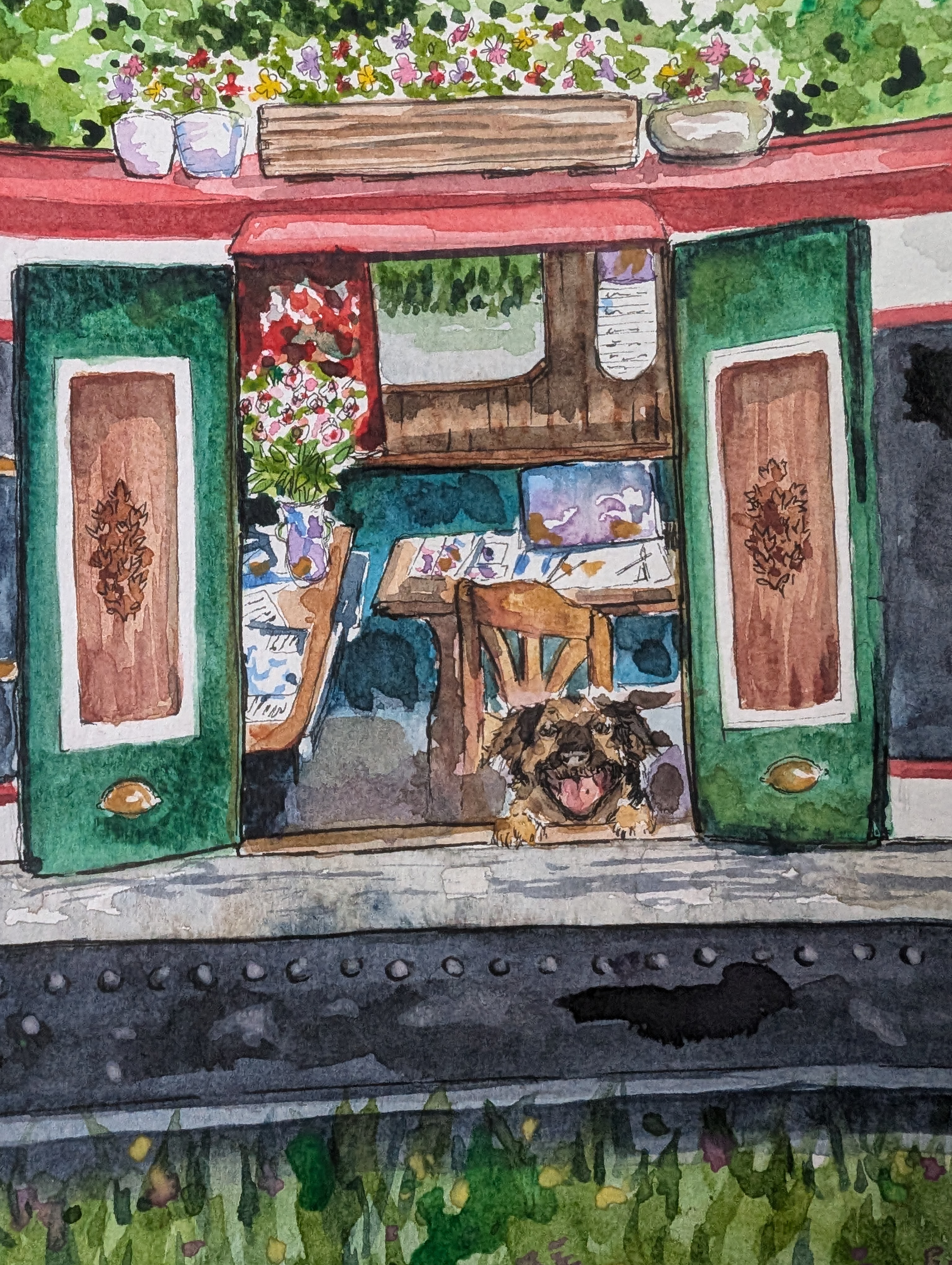
Leela would like you to see our new Fine Art Print, which is now available on the shop- mostly because it is a painting of her on the boat. It is aptly named “Boat Dog” (Leela wanted something grand, but I wanted to stay straight to the point) and is available in sizes A4 and A5. Each one sold goes towards our home’s historical restoration of her hull and interior improvement plans. You can also grab the first art print of Malvern here.
I am so excited to share with you what is in stall this Spring. Medieval history, The Great War, the Second World War, Idle Women, Allotment growing, Dig for Victory, boat jobs, painting AND, of course- writing books. You can watch the episodes early and get access to private blogs and extracts from the fourth Maddox Black book I am still working on, by signing up to be a Patron here.
Sending you all of our love and thank you so much for being here with us.

It really means the world after all of this time,
Elizabeth and Leela x


Leave a Reply